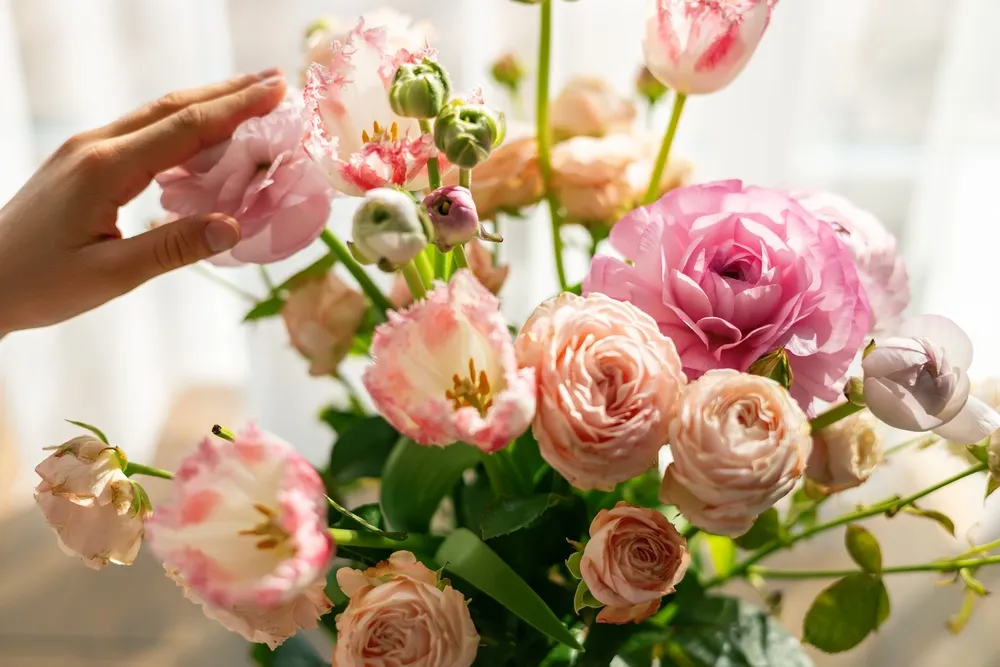
Ranunculus is that type of flower that makes you stop and stare for a couple of seconds. It has many petals, perfectly arranged, intense colors, and an elegant air without being stiff. You often see it in premium bouquets, wedding arrangements, or carefully thought-out decor for special events. But you can also have it at home, in the garden, or in a pot on the balcony.
At Bujor Flower Shop in Iasi, we frequently use ranunculus in Iasi flower bouquets and arrangements because they last well and look impeccable. For example, in this Bridal bouquet with ranunculus, tulips, and roses We combine it with delicate flowers, and the result is balanced and refined. If you are tempted to grow it yourself, you need a few clear rules and a little discipline. It's not complicated, but you can't ignore it completely either.
Let's see how to plant it, how to care for it, and what problems might arise.
Ranunculus doesn't have typical bulbs, but rather corms. They look like dried-up claws, with multiple „fingers” gathered at the base. When you buy them, they should be firm, dry, and free of spots. If they are soft or have an unpleasant odor, do not plant them.
Choose large corms. In most cases, their size directly influences the number and size of the flowers. If you want a rich effect in the garden or in a decorative pot for the terrace, it's worth investing in quality planting material.
In areas with mild winters, ranunculus returns year after year. In our region, Moldova, serious frost affects it. If you leave the corms in the soil over winter, you risk losing them. Many gardeners treat it as an annual plant or dig up the bulbs in the fall and store them.
If you want to keep it for many years, you need to take care of it. It rewards your effort with spectacular flowers in the spring.
Plant in early spring, after the soil reaches about 8–10°C. In Iași, this usually means March or early April. Watch the forecast and avoid periods with severe overnight frost.
If you want prolonged blooming, plant in stages, 2–3 weeks apart. This way you'll enjoy flowers for longer, not just a few concentrated weeks.
Don't plant them directly in the soil. Hydrate them in lukewarm water for 3–4 hours. You'll notice they swell slightly. This step encourages rooting and increases the chances of uniform development.
When planting them, place the „fingers” down. If you put them in upside down, the plant will waste energy trying to orient itself correctly.
Ranunculus prefer well-drained, loose soil with a pH between 6 and 7. If you have clay and compacted soil, add sand, compost, or perlite. Stagnant water quickly leads to root rot.
For stable results, ensure water drains easily. If puddles remain in the area after rain, choose another location or raise the planting bed.
It needs at least 6 hours of sun per day. In very hot areas, it can also tolerate partial shade at noon. Protect it from strong winds, as the stems can break easily.
On the balcony, choose a bright spot, but protected from cold drafts.

Keep the soil lightly moist during the growing period. Do not let the soil dry out completely, but also do not overwater. In most cases, problems arise from overwatering.
After the flowering approaches its end and the leaves begin to turn yellow, gradually reduce watering. The plant enters dormancy and no longer needs the same hydration rhythm.
When the leaves appear, apply a balanced fertilizer. During bud formation, choose one with more phosphorus. Repeat every 2–3 weeks, without doubling the dose.
If you overdo it, you risk burning the roots. Follow the instructions on the packaging.
Constantly remove wilted flowers. This way, the plant produces more buds instead of using its energy for seeds.
If you cut flowers for a vase, cut the stem at a 45-degree angle. At home, repeat the cut every two days and shorten the stem by about 1 cm. Wash the vase with bleach or bleach-based solutions before changing the water. Bacteria reduce the lifespan of flowers.
For everyday use, a bouquet of ranunculus lasts 7–10 days if cared for properly. We offer a guarantee in case of rapid wilting because we work with fresh flowers, brought directly from farms, without intermediaries.
Choose a pot at least 20–25 cm deep with drainage holes. Plant the corms 5 cm deep, spacing them 10–15 cm apart.
If you have a small balcony, plant 3–5 corms in a medium-sized pot. For a rich effect, use a wider pot and combine multiple colors.
On the balcony, the soil dries out faster than in the garden. Check the moisture often. Insert your finger into the soil 2–3 cm deep; if it's dry, water moderately.
The ideal temperature is between 10 and 20°C. If a cold snap occurs, temporarily move the pot to a sheltered space.
If you like decorative houseplants, you can also find other items at our place pot plants suitable for indoor and outdoor use.
After the leaves have completely dried, remove the corms from the ground. Let them dry for 1-2 weeks in a well-ventilated area. Separate the secondary corms that have formed at the base.
Store them at 8–10°C, in peat or sawdust. Avoid plastic bags. Check periodically and remove affected corms.
You can try, but the process takes longer and the success rate is lower. Most gardeners prefer bulb division because it offers more predictable results.
In September or October, after the leaves have dried, dig up the corms. Clean them gently and store them in a cool, dry place.
A ventilated basement works well. Check it monthly. If you notice mold, remove the affected specimens immediately.
Prevention works better than treatment. Space out plants and control watering.
Ranunculus looks impeccable in bridal bouquets, wedding bouquets, or festive table arrangements. We frequently use it in elegant combinations, as well as in minimalist bouquets.
If you want inspiration, check out our collection of bouquets of flowers. Each bouquet is personalized. Our florists ask you about the recipient of the flowers: energetic, discreet, sophisticated, cheerful. We adapt the colors and packaging according to your answers. The packaging is different from what you usually see in a Iași flower shop.
We have bouquets ranging from 100–150 lei, but the average order is 300–350 lei. We also have bouquets for 3,000–4,000 lei for those who want to impress. Delivery is free for orders over 400 lei in Iasi, and outside the city, the cost is calculated based on kilometers. We confirm by phone with the recipient before delivery to ensure the surprise arrives at the right time.
We also create custom wedding candles, wedding bouquets, funeral wreaths, funeral sprays, and funeral bouquets. For weddings, please schedule a consultation 2–3 months in advance. For other products, we can prepare them on the spot, depending on complexity.
If you want to convey a romantic message, you can combine ranunculus with red roses. Learn more about symbolism in the article about red rose. For spring floral gift ideas, including with ranunculus, also get inspired by the guide dedicated to the day of March 8.
Bujor Flower Shop is not just an online and physical flower shop, but also a bistro-cafe space. You can come for a coffee, choose your flowers at your leisure, and leave with a bouquet that truly says something about you.
If you are abroad and want to send flowers to your mother or partner in Iași, order online or call us. Any product on the website can be adjusted over the phone according to your budget. If a flower is out of stock, we will inform you and maintain the color scheme and style of the arrangement.
In most cases, 7–10 days. Cut the stems at a 45-degree angle every two days, trim 1 cm, and sanitize the vase with bleach. Change the water frequently.
In the Iași area, it is not recommended. Frost can destroy them. Remove them and store them in a cool, dry place.
Yes. Keep the plant away from small children and pets. Wear gloves if you have sensitive skin.
Whether you want ranunculus in your garden or prefer to admire them in an elegant bouquet, stop by Florăria Bujor in Iași or order from our online flower shop. Book your wedding flowers in advance, call us for a personalized bouquet, or stop by for a coffee and let us show you what a bouquet truly designed for a specific person looks like.